
Back in 2012, Union City businessman William “Bill” Latimer had an idea that has helped thousands of Tennesseans smile.
“Everyone has medical care in the U.S., because they can always go to an emergency room,” he said. “But you don’t have an emergency place for dental care. I knew a lot of people don’t have the money to go to a dentist, and so I thought that it would be a wonderful idea if we could somehow provide dental care for the underprivileged.”
Latimer offered the College of Dentistry at the University of Tennessee Health Sciences space in a building he owned adjacent to his office on West Main Street in Union City. The generous offer also included funding for equipment.
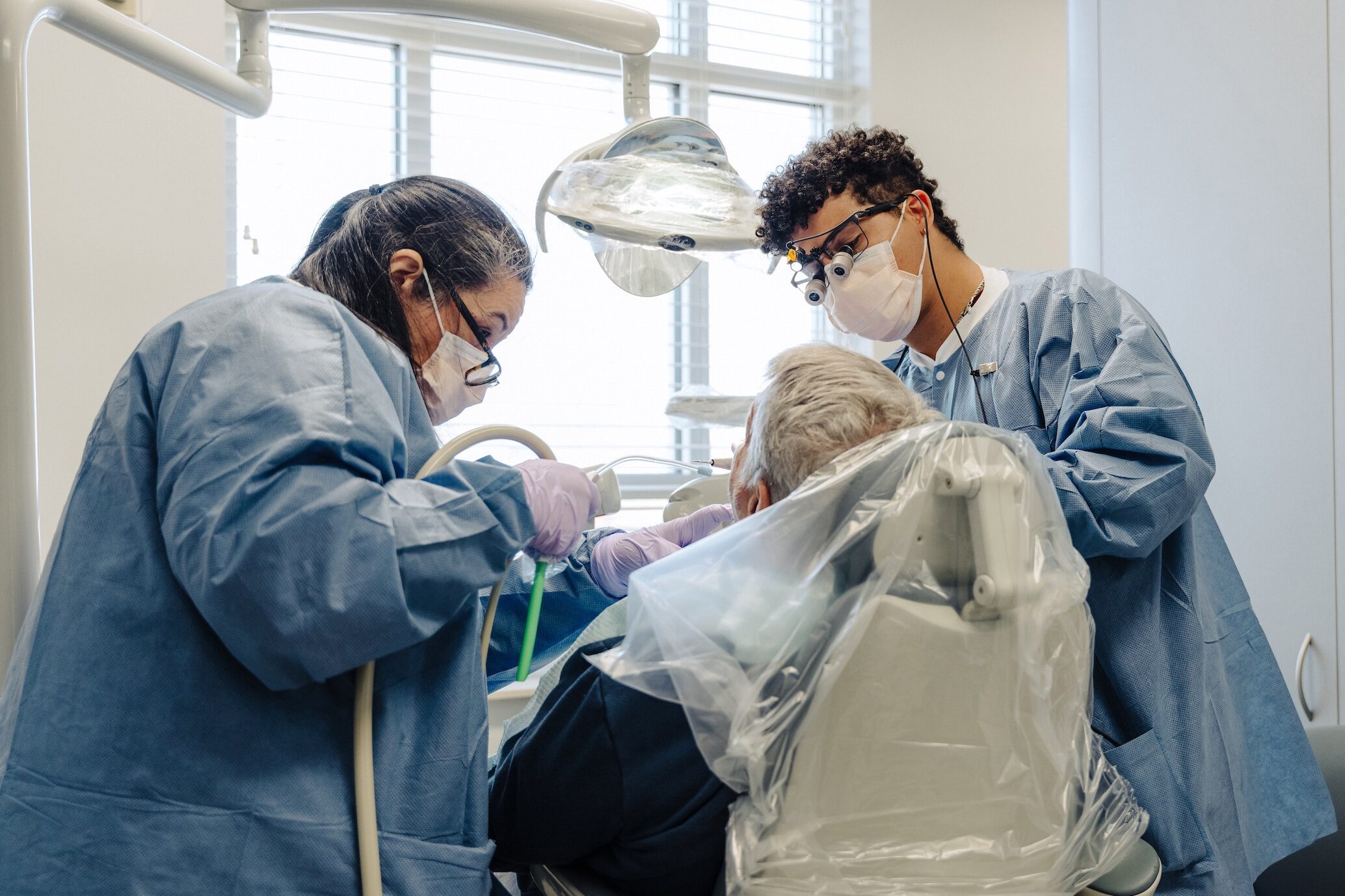
Latimer’s big idea became the University of Tennessee Union City Dental Clinic, which opened in 2015. Staffed by fourth-year dental students and second-year dental hygiene students on two-week rotations and supervised by a faculty dentist, the clinic has provided dental services to thousands of patients who otherwise might not have had care.

That modest facility in West Tennessee has spawned a growing network of dental clinics across the state, all designed to improve the oral health, and in turn, the overall health of countless Tennesseans in need.
“None of this would have been possible without Bill Latimer’s vision and generosity,” said College of Dentistry Dean Ken Tilashalski, DMD. “His willingness to invest in our students and in the health of his community created a model that has transformed how we deliver dental care across Tennessee. We are deeply grateful for his leadership and his belief in what this college, and this state, can accomplish together.”
For his part, Latimer is humble and matter of fact in his motivation. “God has blessed me tremendously, and I do believe that if he has blessed you, you need to turn around and use his blessings to bless others.”
Meeting the Need
In 2023, the Tennessee Department of Health and the College of Dentistry embarked on an ambitious multipronged approach for tackling the shortage of dentists in Tennessee and improving health across the state by making dental care more readily available.
The Department of Health committed a total of $94 million over five years for its statewide Healthy Smiles Initiative. The College of Dentistry received $53 million of the total and set out to increase access to dentists and dental care across Tennessee.
The work continues. Gov. Bill Lee’s latest budget included continued funding for Healthy Smiles.
The need is great.
- U.S. News & World Report ranks Tennessee 43rd in access to dentists for its citizens and 46th in adult dental visits.
- Eighty-six of the state’s 95 counties are partially or fully designated as Dental Health Professional Shortage Areas. Additionally, 26 counties have fewer than 20 dentists per 100,000 people compared to the national average of 60 dentists per 100,000 people. Six counties have no dentists.
- Tennessee will be 800-plus dentists short within 10 years, as the older ranks of licensed dentists retire, according to estimates by the American Dental Association.
Filling the Gap
Educating and training more dentists for Tennessee is a major component of Healthy Smiles.
Healthy Smiles has allowed the College of Dentistry to increase the number of dental students per class to 130, the largest number in approximately 30 years.
At the same time, the dental hygiene classes have grown with 96 students annually in two class starts per year.
“Expanding dental class sizes helps alleviate access-to-care gaps by increasing the number of new dentists entering the workforce and expanding patient care capacity through the clinical services provided by supervised students during training,” Dean Tilashalski said.
From One to Many
Another major focus of Healthy Smiles is providing dental care to the underserved, primarily in rural areas, where access to dental care is lacking. This is being accomplished through the expansion of dental student rotations at clinics in areas of greatest need in the state.
With the Union City clinic as the model, clinical rotation sites outside Memphis are now located in Bristol, Chattanooga, Crossville, Knoxville, and Kingsport. The latter is the newest, the result of a collaboration with community leaders, businesses, and supporters in Kingsport. These clinics are also supervised by faculty and staffed by final-year dental and dental hygiene students on two-week rotations.
It is a win-win formula. Just ask dental student Jake Tomassetti, who was between patients in the Union City clinic on a recent Wednesday afternoon.
“I’ve learned quite a bit,” he said. A few months shy of graduation, Tomassetti was looking forward to being commissioned as a captain in the Army and serving as a dentist. “It’s been great because we’ve been doing a little bit of everything. It’s nice to be able to see multiple patients and do more than we do at the clinic (on campus). We’ve been able to see a patient, see what they need, and treat them as we would if it was our own clinic.”
Additional Tennessee clinics are being discussed for Pulaski, Savannah, and Jackson.

Healthy Smiles has also allowed for an increase in the Advanced Education in General Dentistry (AEGD) residency programs in Memphis and Nashville. A new AEGD program in Kingsport starts this year, thanks to the collaborative relationship there.
“The UT Health Sciences dental clinic in Kingsport is a truly unique, team-based training site, where College of Dentistry students provide patient care alongside ETSU (East Tennessee State University) dental hygiene students and Northeast State Community College dental assisting students, creating a collaborative, real-world learning environment,” Dean Tilashalski said. “With the addition of an AEGD residency site, Kingsport now offers an even stronger continuum of education and care.”
Department of Health Commissioner John Dunn, DVM, PhD, said he is pleased with the progress of Healthy Smiles and what it means for Tennessee. “The feedback from students has been positive. A substantial proportion of students, because of the placements and training and the potential for incentives, are interested in staying in Tennessee and in rural Tennessee.”
One Patient at a Time
In Union City, the clinic closes for lunch on weekdays. When it opens again for the afternoon appointments, it doesn’t take long for the room to fill up with patients.
Marty Reynolds and Stacy Vissering are registered dental assistants, who have worked there since it opened.
“It’s good for our community,” Reynolds said. “There are a lot of people in our community who don’t have insurance and don’t have the means to come to the dentist. So, it’s great for that.”
Vissering seconded that statement. “It’s helping all the people that need help,” she said.
Ed Reese, DDS, is a 1984 graduate of the College of Dentistry and the clinic director. He had spent more than 30 years in private practice before joining the Union City clinic.
“We do as much as we can just to take care of people,” he said, between supervising the students and making sure the clinic ran smoothly. “It’s a great service to the community.”